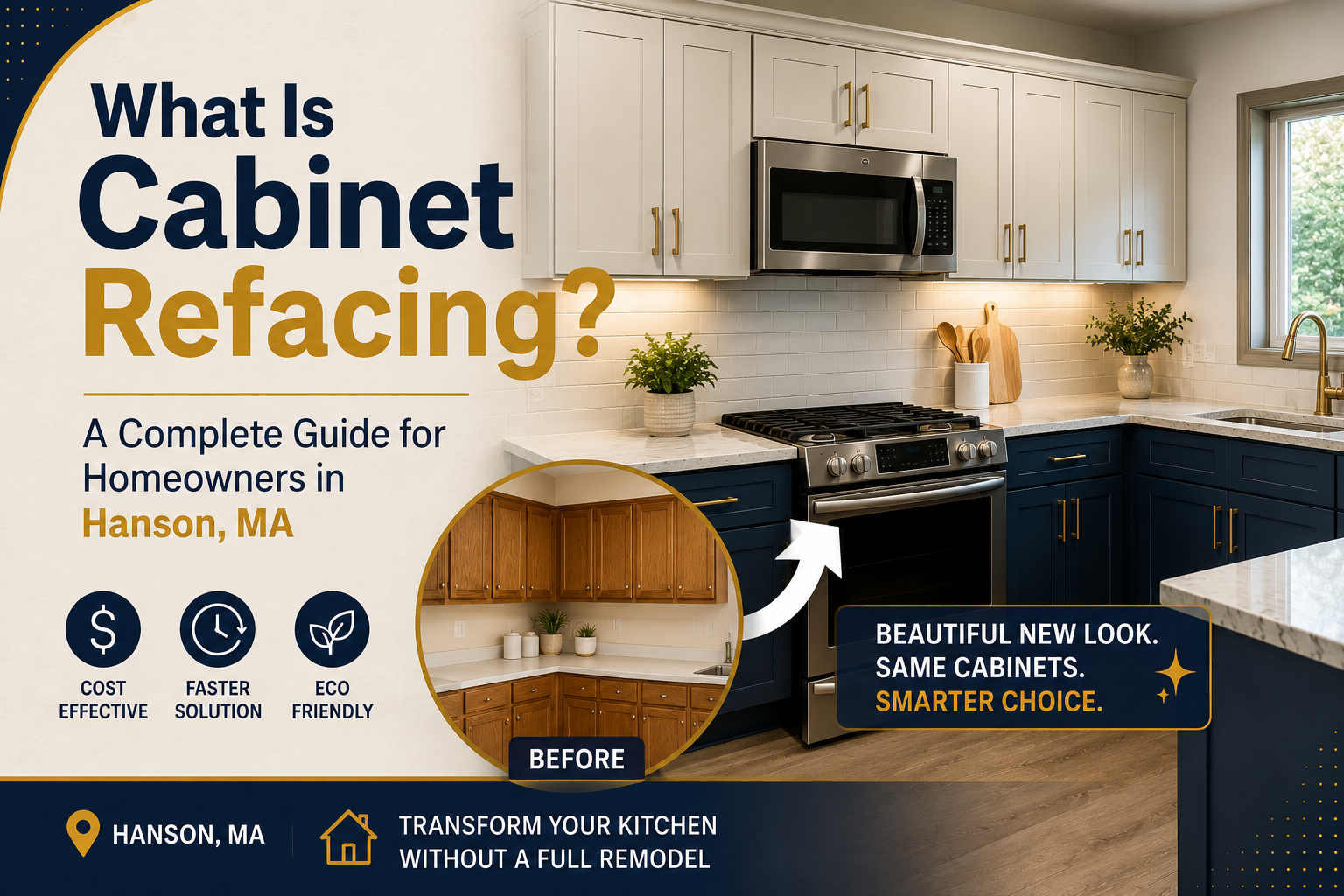
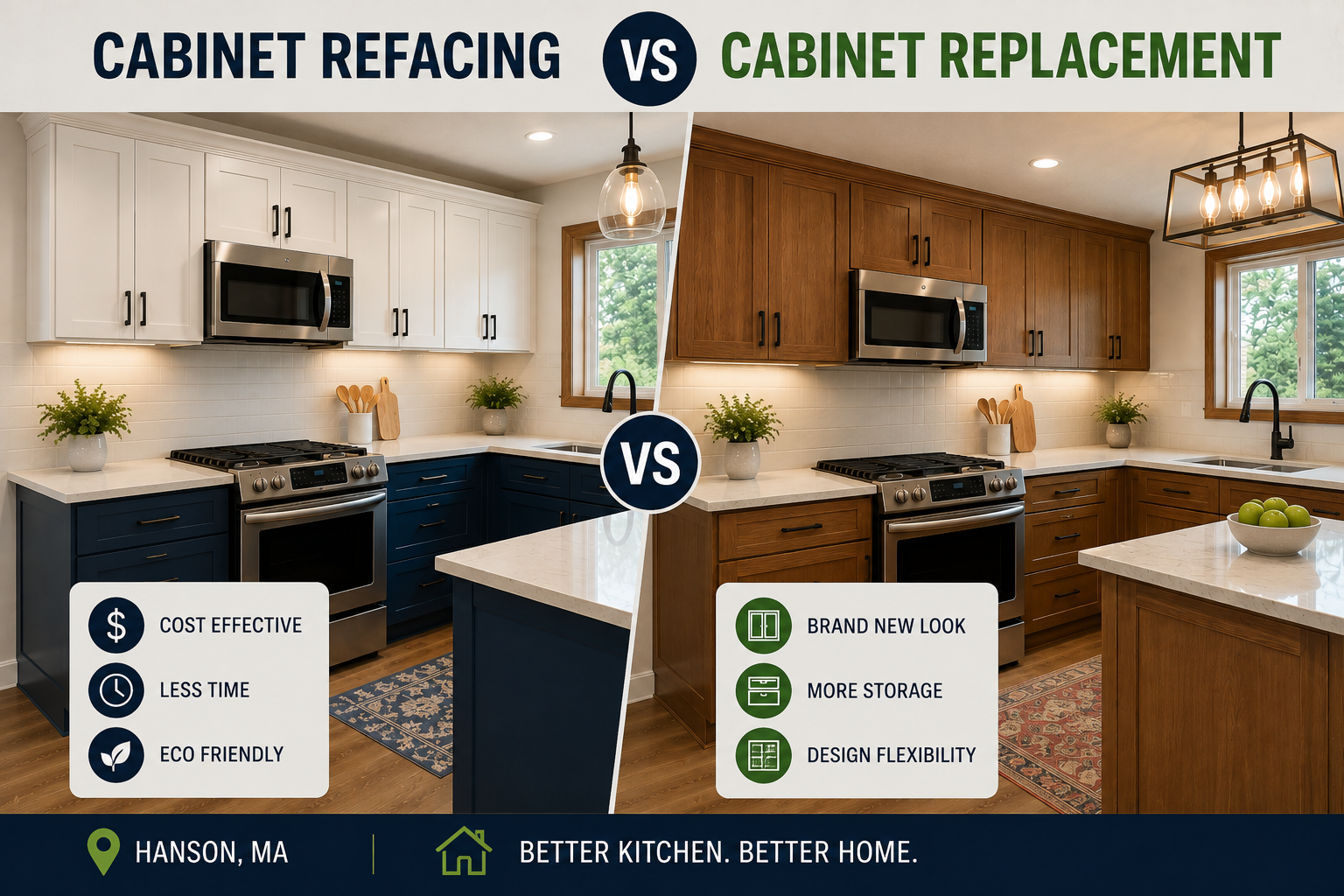
Homeowners typically have two options when the kitchen in their home is out of date: to update existing materials or to replace the cabinets with new ones. Cabinet refacing vs replacement is not simply a question of which option costs less. It will depend on the condition of your cabinets, the size of your kitchen, and the extent to which you want to remodel.
For homeowners in Hanson, MA, understanding the difference can make it easier to choose a renovation approach that fits both the existing kitchen and the desired result.
What Is the Difference Between Refacing and Replacement?
Cabinet refacing involves replacing the existing cabinet boxes with new ones while keeping the cabinet’s interior structure intact. This is typically new doors, drawer fronts, exterior veneer, finishes, and hardware.
Cabinet replacement removes the existing cabinetry and installs a new system. That gives you much more freedom to change cabinet dimensions, storage, layout, and configuration.
| Cabinet Refacing | Cabinet Replacement |
| Keeps existing cabinet boxes | Removes existing cabinets |
| Replaces doors and drawer fronts | Installs entirely new cabinets |
| Can update colors and finishes | Offers virtually complete design freedom |
| Existing layout usually stays | Layout can be redesigned |
| Less extensive construction | More demolition and installation |
| Best when structure is sound | Better when cabinets are damaged or unsuitable |
There is one major difference between refacing and replacement—refacing changes what is on the surface, while replacement changes the cabinetry itself.
When Does Cabinet Refacing Make More Sense?
Refacing is often a strong option when your kitchen already has a layout you like. If the cabinets have sufficient storage capacity and they are placed where you would like them to be, the need to strip out the entire system may be minimal if the doors and finishes are dated.
It can also be effective if the cabinet boxes are adequately constructed. Older cabinetry can be given a completely different look without having to rebuild the base, without the use of new doors, drawer fronts, veneer, and hardware.
Signs Your Cabinets May Be Good Candidates
Look closely at the existing cabinet structure rather than judging the kitchen only by its appearance.
A refacing project may make sense if:
- The cabinet boxes are solid and stable.
- There is little or no water damage.
- Cabinet doors and drawer fronts look worn or outdated.
- The current kitchen layout works for your household.
- You want to update the look with a new finish or door design.
- Your storage capacity is already adequate.
| Quick Note: A kitchen can look old even when its cabinet boxes are perfectly usable. In that situation, replacing everything may solve an appearance problem with a much larger construction project. |
When Does Full Cabinet Replacement Make More Sense?
Replacement is more attractive if there are issues with the existing cabinetry that can’t be addressed with new doors and finishes.
For example, the cabinet boxes can be so badly damaged that they will no longer serve as a stable base for re-facing. The same applies to the daily problems that arise when the layout of the kitchen itself is problematic.
Consider replacement if you need to:
- Move cabinets to create a better workflow
- Add substantially more storage
- Change cabinet dimensions
- Create a new island configuration
- Correct widespread water or structural damage
- Add specialized storage that the existing system cannot accommodate
If you constantly find yourself saying, “I wish this cabinet were over there,” replacement may be more appropriate than refacing.
What About Cost?
Refacing is often considered the more cost-effective option because the existing cabinet boxes remain in place. You are not paying to remove and replace the entire cabinet system.
But that doesn’t necessarily mean refacing is always drastically less expensive. The project may be more expensive if custom doors are used, premium materials are employed, specialty hardware is utilized, decorative elements are added, or a large kitchen is built.
Replacement can also be quite different, as your cabinets can be basic stock or fully custom cabinetry.
Instead of relying on a general percentage or an online average, look at what you are actually getting in each proposal:
Refacing quote: doors + drawer fronts + surface treatment + hardware + installation
Replacement quote: demolition + new cabinet boxes + doors + hardware + installation + potential modifications
The best option will be based on your kitchen’s existing capabilities and your desired new functionality.
Which Option Gives You More Design Freedom?
If the objective is to alter the look, refacing can offer a lot of flexibility.
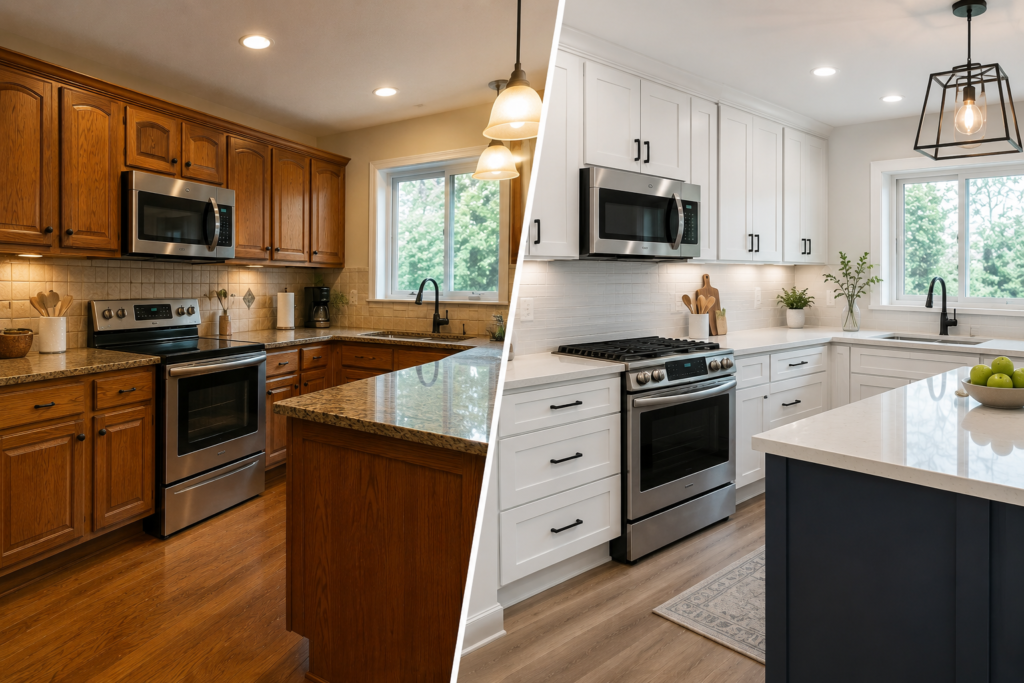
You can select a new door profile, color, finish, hardware, and decorative elements. A kitchen with older wood doors, for example, can be transformed with a cleaner contemporary door style and a lighter finish.
The design range of replacement is broader since you are not constrained by existing cabinet box dimensions and placement.
How Does Cabinet Condition Affect the Decision?
In many refacing projects, the cabinet box is the determining factor.
Check the normally concealed areas by opening a few doors. Check for softness, cracks in panels, loose joints, or signs of moisture conditions around sinks.
Attractive doors can be installed on a cabinet, but the cabinet may have structural issues. On the other hand, a cabinet with cruddy doors might be perfectly fine despite the old look of its doors.
If the existing structure is in good condition, cabinet preservation can make sense. If the structure itself has deteriorated, putting new surfaces over it may not be the best long-term solution.
What About the Kitchen Layout?
This is one of the simplest methods to determine between the two alternatives.
Suppose your Hanson kitchen has enough storage, the work triangle feels comfortable, appliances are positioned correctly, and you like the existing cabinet locations. In that case, refacing can focus your renovation on the appearance.
But if you need to move the sink, relocate appliances, remove a cabinet wall, add significantly more storage, or redesign the island, replacement provides much more flexibility.
Refacing preserves the existing footprint. Replacement gives you the opportunity to rethink it.
Refacing vs. Replacement: A Quick Decision Guide
| Your Situation | Likely Better Option |
| Cabinets are structurally sound | Refacing |
| You like the current layout | Refacing |
| Doors look outdated | Refacing |
| You want a new color or style | Refacing |
| Cabinet boxes have major damage | Replacement |
| You need more storage | Replacement |
| You want a different layout | Replacement |
| Cabinet dimensions no longer work | Replacement |
| You are planning a major kitchen redesign | Replacement |
This is not an absolute rule, but it provides a useful starting point before requesting estimates.
What Should You Ask Before Choosing?
Do not compare cabinet refacing services in Hanson based only on the final price. Make sure you understand exactly what is included.
Ask the contractor:
- Will the existing cabinet boxes be inspected before the project begins?
- Which doors, drawer fronts, and surfaces will be replaced?
- What material will be used for the new exterior surfaces?
- Are hardware and hinges included in the estimate?
- Are decorative pieces such as crown molding included?
- What happens if damage is discovered after work begins?
- How long is the workmanship covered?
These questions allow you to gauge proposals based on the real scope and not just the number at the bottom of the quote.
Common Mistake: Choosing Based Only on the Lowest Price
The lowest quote is not always the best deal. So if one bid includes basic materials and the other includes a higher-grade door, better hardware, more careful preparation followed by additional surface work, then these two prices are not truly equivalent.
The same applies to replacement. A low cabinet price may not include demolition, disposal, installation, modifications, or other work required to complete the kitchen.
For a homeowner considering cabinet refacing in Hanson, Kitchen Redux can help make the options easier to understand based on the condition and design of the existing kitchen.
Frequently Asked Questions
Can I reface cabinets if I want a different door style?
Yes. The biggest benefit of refacing is replacing doors and drawer fronts. An older, more dated raised-panel cabinet style can frequently be swapped out for a Shaker or slab-style look without replacing the boxes of the cabinets themselves.
How long can refaced cabinets last?
If done correctly, a refacing project will deliver years of service, but the timelines likely depend on the quality of materials, installation practices, and how cabinets are used in day-to-day situations. The underlying cabinet boxes still matter because they remain part of the finished system.
Can refacing fix damaged cabinet boxes?
Not always. While minor surface issues may well be addressed during prep, extensive water damage, rot, or structural failure might necessitate cabinet replacement instead.
Is cabinet replacement always better for a long-term renovation?
No. If your existing cabinet structure is sound and the layout works well, replacing usable cabinetry may add unnecessary work and expense. Replacement becomes more compelling when you need structural or functional changes.
Final Thoughts
The better choice between cabinet refacing vs replacement comes down to what you want your Hanson kitchen to accomplish. If the cabinet boxes are structurally sound, the layout works, and your main goal is a new appearance, refacing can provide a substantial kitchen upgrade while preserving usable cabinetry.
If the cabinets are damaged or the layout, storage, and functionality all need major changes, full replacement may be the more suitable investment.
If you are unsure which direction makes sense for your kitchen, Kitchen Redux can help you evaluate whether preserving the existing cabinet structure or starting with new cabinetry better matches your renovation goals.