
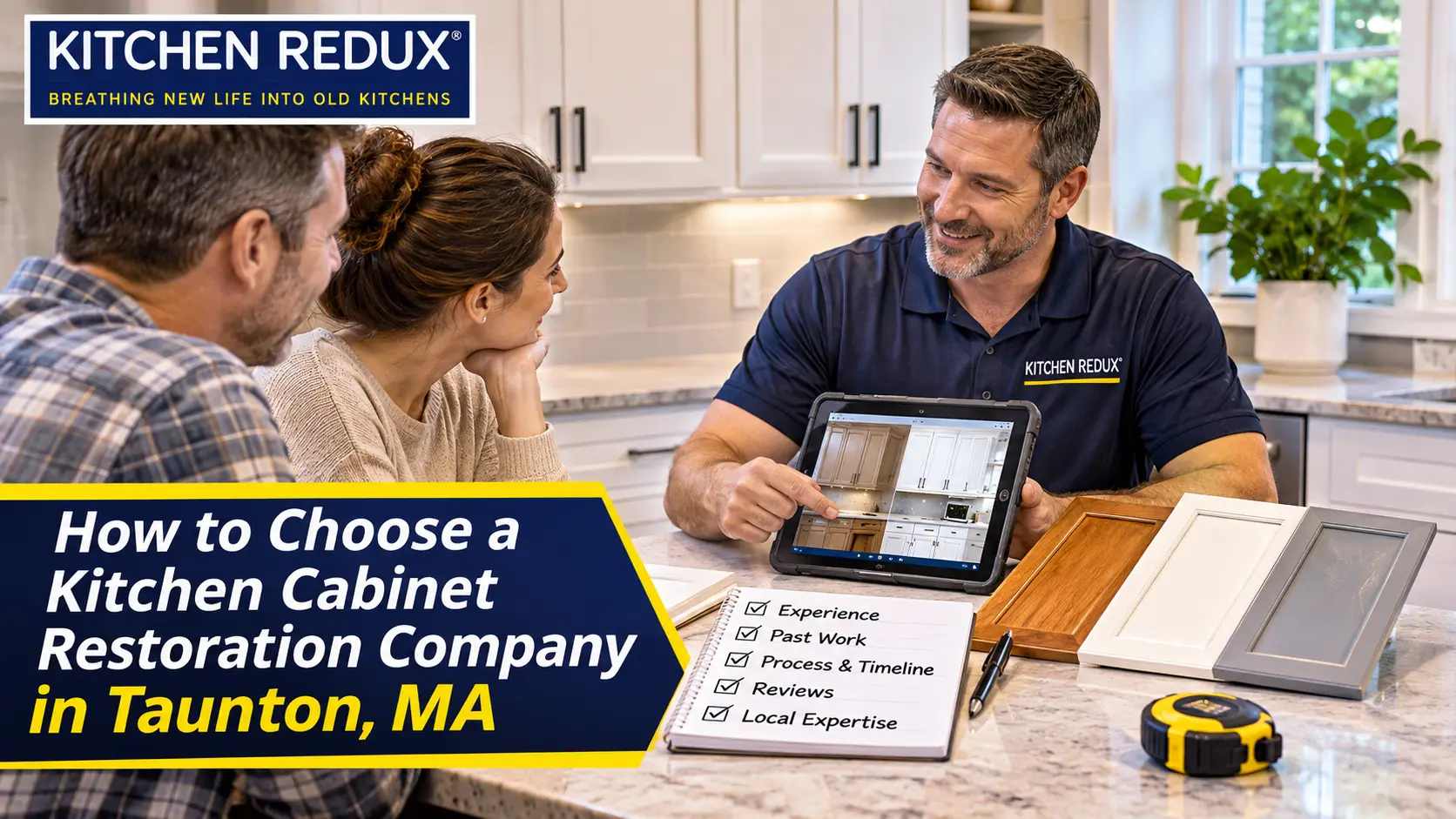
Your kitchen layout still works. The cabinets just look tired. Stain has worn pale around the handles, and the doors near the stove feel tacky. A good kitchen cabinet restoration company can fix much of that without tearing anything out. Price alone won’t tell you who to hire, though.
Homeowners in Taunton, Massachusetts should check experience and registration first. Then judge how carefully each contractor looks at the cabinets and writes the estimate. The short answer? Hire the contractor who inspects your cabinets closely and explains which options fit. They should give every detail in writing. They should also show you work like yours.
Evaluate the Experience and Qualifications of a Cabinet Restoration Company
Look for Relevant Cabinet Restoration Experience
Marketing copy is easy to write. Experience shows in how a contractor answers questions. Ask what kinds of cabinets they usually handle. A crew that mostly restores stained oak may have little practice with painted MDF or peeling veneer. General painting isn’t the same skill. An experienced cabinet restoration contractor will tell you plainly what restoration can and can’t fix.
Verify Registration, Insurance, and Applicable Compliance Requirements
Massachusetts requires contractors to register as Home Improvement Contractors (HIC) for work on existing owner-occupied homes with one to four units. Some exemptions exist. Ask for the HIC number and check it with the state. Next, request a certificate of liability insurance. If the company has employees, ask for proof of workers’ compensation. The state generally requires it from the first employee.
Older homes add one more step. In a pre-1978 house, work that disturbs more than a small area of painted surface can fall under lead-safe renovation rules. Massachusetts licenses lead-safe renovation contractors through the Department of Labor Standards. Not every cabinet job crosses that line. Ask whether yours does. Then ask who handles compliance.
Assess Your Cabinets Before Hiring a Professional
Distinguish Surface Wear From More Serious Damage
Your cabinets’ condition decides what’s possible. Scratches and faded stain are surface problems, and so is a dull or greasy finish. Loose hinges and chipped door edges are usually fixable. Peeling veneer on kitchen cabinets needs a closer look. So do damaged drawer fronts. Swelling or soft spots in the cabinet boxes are the worst signs, especially after a leak. Cosmetic wear rarely means replacement. Structural or moisture damage might.
Consider the Existing Cabinet Material
Solid hardwood can often be repaired and refinished. Plywood with intact wood veneer often responds well too. MDF is different. It takes paint well but doesn’t handle moisture. Swollen particleboard usually can’t be brought back. Good cabinet repair and restoration services start with an honest look. Skip that step, and you’re buying a guess. A useful damaged cabinet assessment should tell you:
- Which parts can reasonably be repaired
- Which surfaces will accept a new finish
- Whether any damage affects structural integrity
- What limits or other options you should know about
Compare Kitchen Cabinet Restoration Services in Taunton, MA
Look for a Contractor Who Explains More Than One Suitable Option
Does the company recommend what your cabinets need, or just the service it sells most? Contractors use a handful of terms, and they don’t always mean the same thing. A good one defines them in plain words before quoting a price. Here’s what the common terms mean:
- Restoration: repairing suitable damage and refreshing the existing look
- Refinishing: preparing the surface for a new stain or clear finish
- Painting: applying a compatible paint system to change or refresh the color
- Refacing: new doors and drawer fronts and fresh veneer over sound cabinet boxes
- Replacement: removing the cabinets when repair or a cosmetic update won’t do the job
Check Whether the Recommendation Matches Your Cabinets
A contractor worth hiring ties the method to what they saw. They explain its limits and any trade-offs. They’ll also say when restoration isn’t worth it. Be wary of anyone who claims a new finish will fix rot or a failing cabinet box. When comparing kitchen cabinet restoration services in Taunton, MA, remember that the longest service menu doesn’t win. Clear reasons tied to your cabinets do.
Examine the Preparation, Finishing Process, and Quality Checks
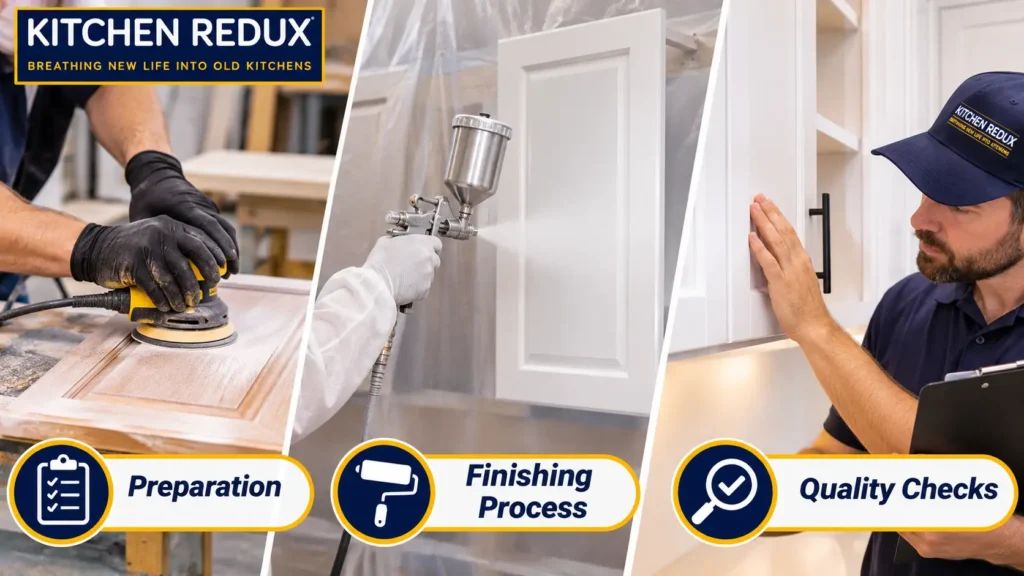
Ask How the Contractor Plans to Prepare and Finish the Cabinets
Most of a good finish happens before the finish goes on. Grease near the range can make a new coat cloud or peel. Cleaning comes first. Surface prep follows, based on the material and finishing method. Repairs come next, from filling scratches to regluing veneer or tightening loose hardware. Ask which restoration materials they’ll use and why they suit your finish. Methods differ by job type.
Confirm How the Final Work Will Be Inspected
Agree on the final check before work starts. That way, nobody argues about what “done” means on the last day. Walk the whole kitchen together when the crew wraps up. Bring your copy of the written estimate. Ask exactly how they’ll review each of these points:
- Finish consistency across visible surfaces
- The repairs you agreed on
- Any visible defects
- Door and drawer operation
- Hardware alignment, where relevant
- Touch-ups and outstanding items
Compare the Restoration Estimate, Project Scope, and Timeline
Understand What the Written Estimate Covers
A solid estimate spells out every cabinet part and surface it covers. It explains the prep and repairs. It names the materials and finishing methods. Hardware changes and a project timeline belong there too. So do exclusions and payment terms. Check how extra work gets approved. If you can’t tell what’s included, the project scope is too vague. In Massachusetts, home improvement contracts over $1,000 generally must be in writing.
Compare Estimates on Equivalent Terms
The lowest restoration estimate isn’t the best deal if it covers less work. A cheaper bid may skip prep or repairs. A pricier one isn’t automatically better. The gaps in each quote show you what to ask next. Use this table to line up two or three proposals side by side:
| Comparison point | What to check |
| Preparation | Cleaning, repairs, and surface treatment |
| Materials | Proposed products and finish compatibility |
| Included work | Doors, drawers, cabinet boxes, and hardware |
| Timeline | Estimated start date, duration, and scheduling |
| Terms | Payment, exclusions, and applicable warranty |
Verify Workmanship, Reviews, and Local Project Evidence
Review Before-and-After Photos and Relevant Projects
Proof beats promises. Look for projects that match your materials and damage. Zoom in on the color from door to door. Is it even, or does one panel look a shade off? Check the repaired spots and drawer fronts. Then make sure the photos show the company’s own work, not stock images.
Check Reviews and Ask About Local Experience
Specific comments about prep and communication in recent reviews beat five stars with no details. Ask whether the company does in-home assessments in Taunton. Ask to see finished projects in or near town, and ask for a reference. A local cabinet restoration company that has worked nearby can show relevant examples. Still, a town on a service-area page doesn’t prove similar work there.
Red Flags to Avoid When Hiring a Cabinet Restoration Contractor
Pressure and fuzzy terms make it hard to compare contractors fairly. A good company gives you time to think it all over. One red flag doesn’t prove fraud. Still, it’s a good reason to dig deeper before you go further. Watch for these five signs:
- No written contract: the scope and price never make it onto paper
- A large upfront deposit: Massachusetts generally caps it at the greater of one-third of the total price or the cost of special-order materials
- Pressure to sign the same day: you’re pushed to skip comparing quotes or reading terms
- A vague scope of work: the proposal doesn’t name what’s included
- Refusal to show past work: they won’t share similar jobs
Make Your Final Choice and Prepare for the Project
You’ve probably narrowed the field to one or two contractors by now. Take your time. Before you sign, run through one last check. You should be able to say yes to every point below. If anything is still unclear, sort it out before you commit.
- They showed relevant cabinet restoration experience
- Registration and insurance questions got clear answers
- Lead-safe questions were covered if your home predates 1978
- They assessed your cabinet condition and materials
- The proposed method fits your cabinets and goals
- The written estimate covers scope, terms and exclusions
- Reviews and local project examples checked out
Frequently Asked Questions
Can I use my kitchen while the cabinets are being restored?
Usually, at least in part. Access depends on the work area and ventilation. It also depends on drying or curing time for the products used. Some finishes need extra time before dishes can go back on a shelf. Ask upfront which areas will be off-limits and for how long.
How should I prepare for an in-home cabinet assessment?
Clear space so every door and drawer opens fully. Note the problems that bother you most, like peeling spots or sticky doors. Decide on the color and finish you want. A photo or sample helps a lot. With that ready, the visit stays focused on your kitchen and your goals.
Can cabinet restoration be completed in stages?
Sometimes, depending on the scope and your layout. You might do the lower cabinets first and the uppers later. The catch is matching. Color and sheen can be tricky to match across phases. Confirm that a phased plan is truly practical before you agree to it.
How long does kitchen cabinet restoration take?
That depends on how many cabinets you have and what shape they’re in. Prep work changes the schedule. So does the finishing method. A few lightly worn doors go faster than a full kitchen with repairs. Ask for a timeline based on your actual kitchen.
Get Your Taunton Cabinets Assessed by Kitchen Redux
A good hiring decision starts with a proper assessment. Then you need a recommendation that fits. Clear written terms come next. Last comes proof of relevant workmanship. Get those four pieces right, and the rest gets a lot easier. Miss one, and you’re taking a gamble with your kitchen.
Kitchen Redux helps homeowners in Taunton and nearby communities restore cabinets that look worn but remain structurally sound. The company offers free in-home consultations and written estimates. Call (774) 773-8387 to ask questions or schedule your consultation.