
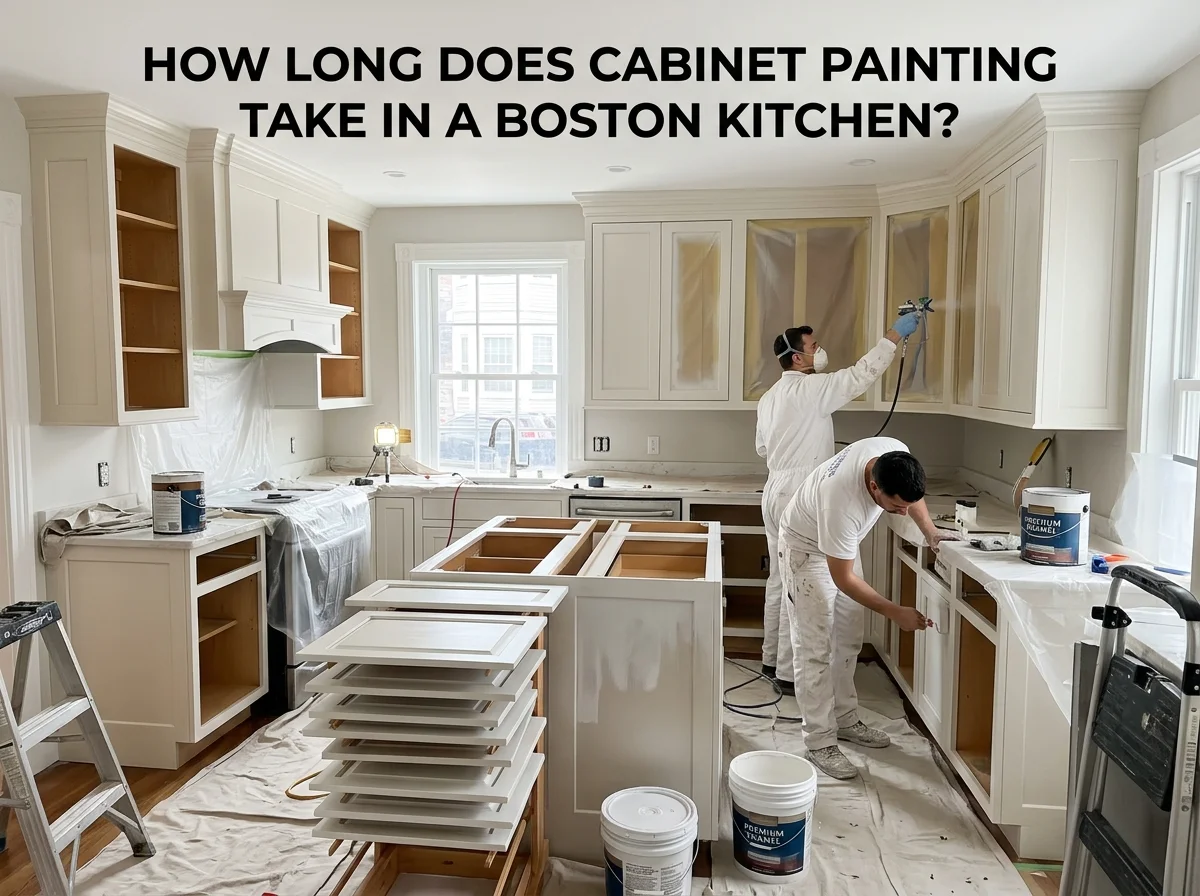
Most professional cabinet painting projects fall somewhere between three and seven business days for a full kitchen, doors and drawers included, whether you’ve got a tight galley layout or a bigger kitchen with a run of uppers and lowers plus an island. That’s a typical range, not a promise, since every kitchen is different. What that number doesn’t include is the curing that keeps happening after the team packs up and your kitchen already looks finished. So how long does cabinet painting take for your particular kitchen? It hinges on how many cabinets you’re dealing with, what condition they’re in, and whether the painter is spraying or brushing.
The Timeline, Broken Down by What Actually Happens
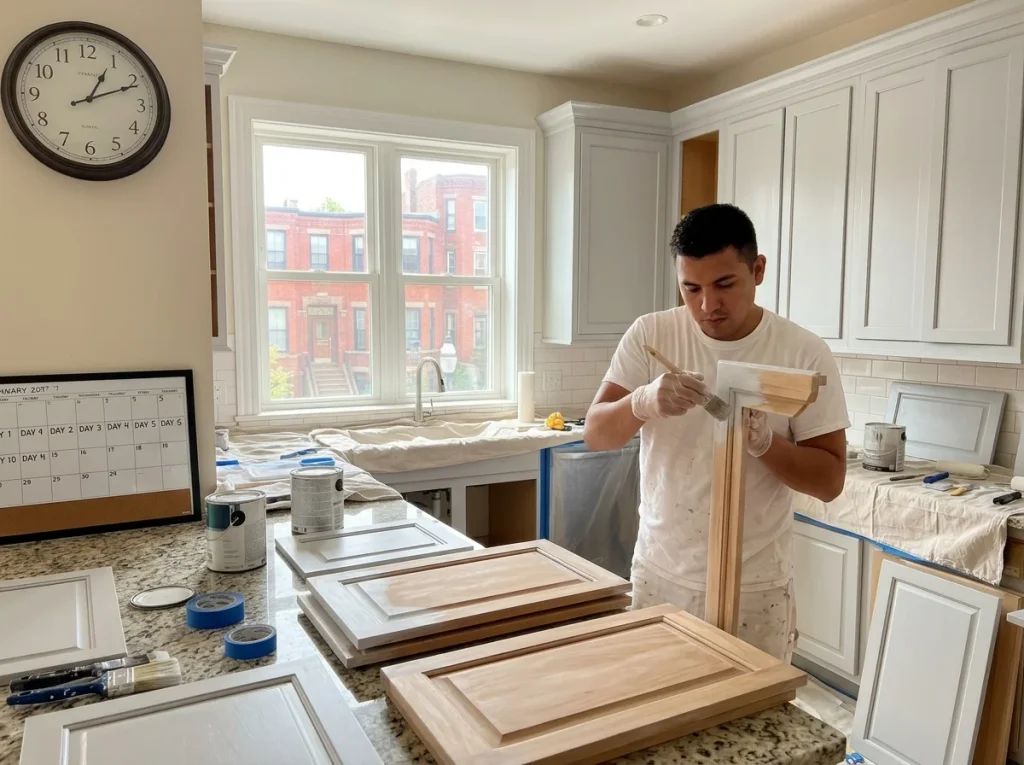
A cabinet job isn’t one continuous task. It’s a string of steps, and each one needs its own window of time. Try to compress them, and it usually shows up later, sometimes as soon as the first time you wipe down a door. Roughly speaking, removal and setup happen on day one, cleaning and sanding run into day two, priming and dry time carry into day three, paint coats go on across days three through five, and reassembly and inspection wrap things up by day five to seven. That’s a typical sequence, and the exact days can shift depending on your kitchen.
Day One: Removal and Setup
Day one is almost entirely logistics. Doors come off. Drawer fronts come off. Hardware gets bagged and labeled so nothing gets mixed up when it’s time to put everything back. Countertops and floors get covered. None of this is glamorous work, but a rushed setup on day one has a way of costing you time three days later.
Day Two: Cleaning and Sanding
From there, cleaning and degreasing come next, usually spilling into day two. Kitchen cabinets carry a film of grease you can’t always see just by looking, especially the ones near the stove or above a range. Grease can interfere with paint adhesion, so proper cleaning is an important part of the preparation. Sanding follows right after, roughing up the old finish so primer actually has something to grab onto.
Days Two to Three: Priming and Dry Time
The primer goes on around day two or three, and then you wait. Primer is doing real work here. It blocks old stains and wood tannins from bleeding through your new paint color, and it gives the topcoat a surface it can actually bond to instead of just sitting on top. How long you wait before the first coat of paint depends on the product and the weather that week, and this is also the point where dry time and cure time start to matter as two separate things. More on that below.
Days Three to Five: Paint Application
Paint application usually runs from day three through day five. Most cabinets need two to three coats to look even and hold up over time. Each one needs a little dry time before the next goes on. Spray painting lays down smoother and faster per coat than brushing, though it comes with more prep, more masking, and more plastic sheeting taped up around the room to catch overspray.
Days Five to Seven: Reassembly and Inspection
The last stretch, usually days five through seven, is reassembly. Doors go back on their hinges. Hardware gets reinstalled. A good painter walks the kitchen door by door at this point, checking that everything’s aligned and closing right, touching up anything that needs it. This part moves fast, and it’s usually the moment the kitchen suddenly looks done, even though the paint underneath still has weeks of curing left in it.
Dry Time and Cure Time Are Not the Same Thing
Here’s where a lot of people get caught off guard, and it’s worth spending real time on. Dry time is just how long paint takes to stop being tacky, to the point where you can touch it or hang a door back up without leaving a mark. Depending on the product, that might only take a few hours.
Curing is a slower process happening underneath the surface. The paint film is hardening all the way through, not just on top, and full cure often lands somewhere in the range of two to four weeks. That window isn’t fixed, though. It shifts depending on the specific cabinet coating, what the manufacturer’s instructions actually call for, and the temperature and humidity in your kitchen while it’s drying. A cabinet can look completely finished and still be soft underneath.
That’s the part homeowners miss. Doors go back on, and the kitchen goes back into use well before the finish is fully cured, and that’s fine for normal cooking and everyday traffic. But go easy on things early. A wet dish towel left hanging on a door edge, a drawer slammed shut out of habit, aggressive scrubbing on a stubborn spot—any of that can leave a mark during the curing window that wouldn’t happen once the finish has fully hardened. Give it those few weeks, and the paint holds up for years.
What Actually Slows a Project Down
No two kitchens run on the same clock, and it’s rarely one single thing that stretches a timeline. It’s usually a combination.
Kitchen Size
Size matters in an obvious way. A full wall of uppers plus a large island is just more square footage to cover, coat after coat, than a small galley kitchen.
Cabinet Condition
Condition matters more than most people expect. Cabinets with years of grease buildup, water damage around the sink, or old lacquer that’s already flaking need real prep work before a coat of primer touches them. That extra prep adds real days.
Spray vs. Brush and Roll
Spray versus brush changes the math too. Spraying tends to be faster per coat and leaves a smoother finish, but it needs a proper containment setup. Brush and roll work skips some of that setup time but takes longer to lay down evenly, coat after coat.
Weather Conditions
Weather plays a bigger role here than people think, especially in New England. A muggy stretch in July can slow drying down noticeably. So can a dry, cold snap in January. Either one can push dry time and cure time past what the paint can label promises, since those numbers usually assume ideal conditions.
Color Changes
Color changes add time too. Going from a dark stain to a bright white, or the reverse, often means an extra coat of primer or paint just to fully cover what was there before.
Cabinet Style
And cabinet style counts. Detailed panel doors, glass-front cabinets, and anything with heavy molding take longer to prep and coat evenly than a plain flat-slab door. More edges, more corners, more time with a brush or a spray gun getting into every groove.
Put those together, and you can see why a generic online chart never quite matches what actually happens in your kitchen. A painter walking through your space, or at minimum looking closely at photos, gives you a real number instead of a guess.
Your Kitchen During the Project
Access is usually better than people expect going into it. Your sink, countertops, and appliances may remain usable during much of the project, but access can vary depending on how the crew sets up and which areas are being worked on. You’ll have plastic sheeting up and a staging area somewhere for doors and hardware, but you’re not locked out of your own kitchen.
Boston adds a wrinkle worth mentioning. Older triple-deckers and condo buildings can come with narrower layouts and tighter hallways than a newer suburban build, and compact kitchens with limited staging space can affect where a crew sets up doors and hardware while they’re off the cabinets. It’s one more reason a walkthrough before the project starts is worth the time, so your painter can plan around your specific space instead of guessing.
Keeping Things on Schedule
Delays can come from surprises such as cabinet damage that isn’t found until the doors are removed or a color change halfway through the project. A short walkthrough before the crew shows up catches most of this early, back when it’s still easy to plan around. Clear out cabinet contents and countertop clutter before the crew arrives. Sounds small, but it lets prep start right on time instead of an hour late.
Pick your color and finish before the start date and stick with it. Changing your mind mid-project can add a full coat and another round of drying. Ask for a real day-by-day schedule, not just a total number of days. It’s a lot easier to plan your week around specifics. If getting your kitchen back sooner is the priority, ask directly about the reassembly day and build your plans around that.
Common Questions
How long does it take to paint kitchen cabinets without removing the doors?
Painting cabinets without removing the doors usually takes 2 to 4 days, depending on the cabinet count, condition, prep work, and drying time. Leaving the doors attached can save reassembly time but makes painting edges and areas around hardware more difficult.
Can I use my kitchen the same day cabinets are painted?
When the coating is dry enough for handling, you may be able to use the kitchen lightly. Follow the coating manufacturer’s instructions and treat the finish gently while it continues to cure.
Does repainting cabinets take less time than painting them for the first time?
Sometimes, if the existing finish is in decent shape and doesn’t need heavy sanding. But cabinets with peeling paint or bare stained wood need the same full prep either way.
Why do some quotes list a much shorter timeline than others?
Usually it means fewer coats, shorter drying windows between coats, or steps that got skipped somewhere. Worth asking exactly what’s included before comparing two numbers side by side.
Does Boston weather actually affect cabinet painting time?
Yes, genuinely. Humid summer stretches and dry winter cold both change how paint dries and cures, and painters who work here year-round adjust their scheduling by season rather than sticking to one fixed number.
Can cabinet painting really be completed in three days?
Yes, for a smaller kitchen in good condition, three days can be realistic. Fewer doors, minimal repairs, and good drying conditions can help keep the job on schedule. Larger kitchens or cabinets needing more prep usually take closer to five to seven days.
Want a Real Timeline for Your Kitchen?
Every kitchen paints out a little differently, and the only way to know yours is to actually look at it. Kitchen Redux walks through your kitchen, checks cabinet condition and layout, talks through your color plans, and puts together a realistic day-by-day schedule before anything starts. Reach out to Kitchen Redux and get a timeline built around your actual cabinets.