
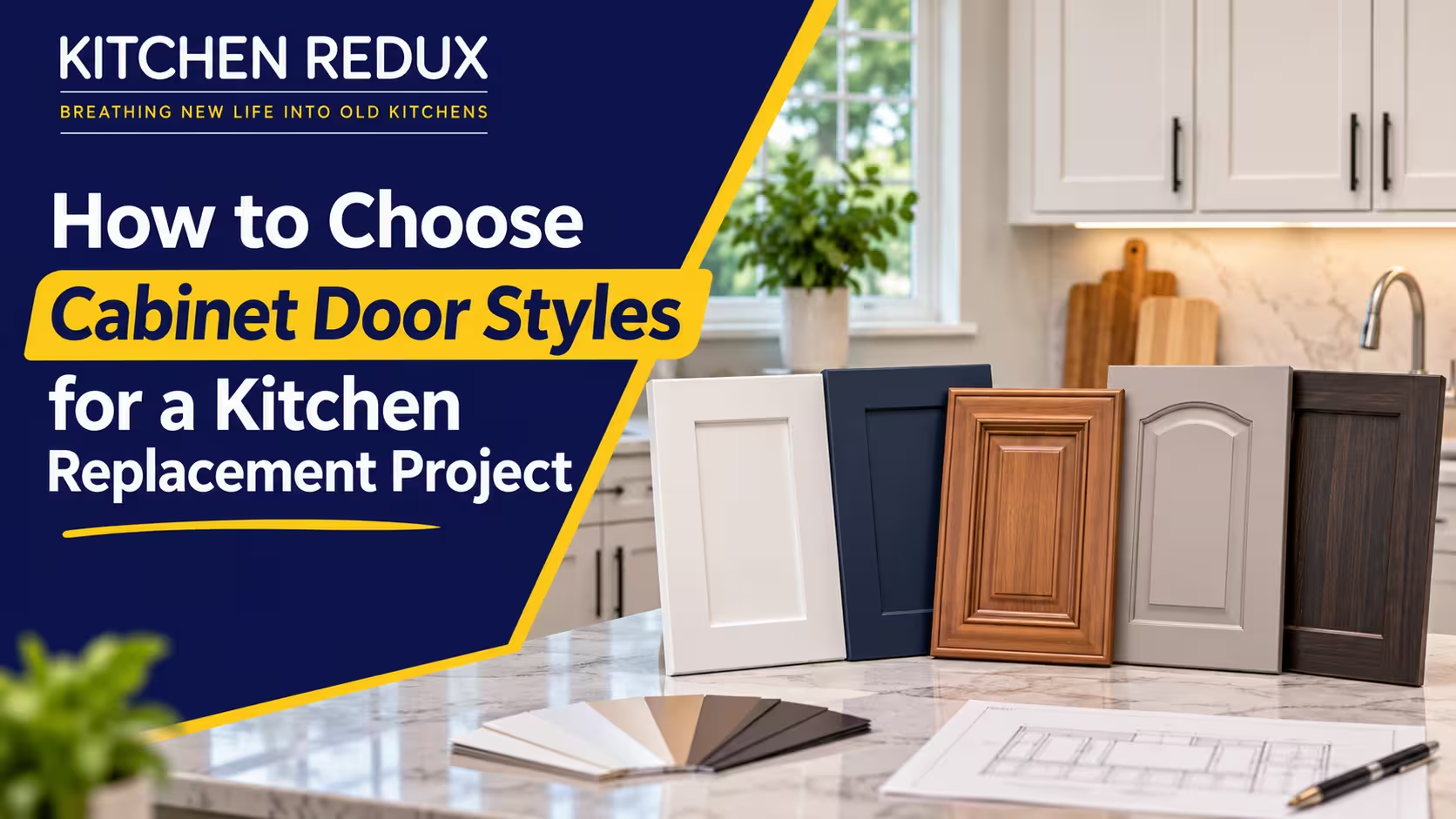
Pick the door that fits the kitchen already in place, then make sure it suits how the household actually cooks and cleans. Kitchen cabinet door styles cover more surface than any other finish in the room, so the door profile sets the tone for the whole replacement. A plain slab reads modern, and a raised panel reads classic, while Shaker lands in between and shows up almost everywhere. Looks only tell half the story. The door also has to work with the cabinet box and overlay behind it, plus the finish and hardware on its face. This guide covers each of those points so a homeowner can cut a long sample list down to two or three real contenders.
What Should Homeowners Consider Before Choosing a Cabinet Door Style?
Showroom walls full of sample doors overwhelm people fast, and the kitchen itself makes a better starting point. Two questions narrow the field: what does the room already look like, and how hard will the household use it?
Start With the Kitchen’s Existing Design Character
Flooring and backsplash tile often stay put during a cabinet replacement, so the new doors have to get along with them. Busy granite or patterned tile usually pairs best with a quiet door because two detailed surfaces compete for attention. Check the trim too. Heavy curved casings point toward a traditional door, while thin square trim leans modern.
Balance Appearance With Everyday Practicality
Every groove and ledge on a door gives grease and dust a place to settle. A slab door wipes down in seconds, while a Shaker has four inside corners where grime can collect. Beadboard grooves and carved raised panels add even more spots to clean. Very dark or high-gloss finishes also tend to show fingerprints near the sink and trash pull-out.
Which Kitchen Cabinet Door Styles Are Worth Comparing?
Catalogs list dozens of door names, but most are variations on four basic profiles. Lining those four up side by side gives a homeowner a clear reference point before diving into catalogs.
| Cabinet Door Style | Visual Appearance | Best-Suited Kitchen Design | Key Consideration |
| Shaker | Simple frame with a recessed center panel | Transitional, traditional, and contemporary kitchens | Offers a balanced level of detail |
| Slab | Smooth, flat, uninterrupted surface | Modern and minimalist kitchens | Shows a clean, simple profile |
| Raised Panel | Center panel with a raised decorative surface | Traditional and classic kitchens | Creates a more detailed appearance |
| Beadboard | Vertical grooves and textured detailing | Farmhouse and cottage-inspired kitchens | Grooves may require more attention during cleaning |
Shaker Doors for Clean, Adaptable Design
Shaker doors use a five-piece build, with two vertical stiles and two horizontal rails framing a flat panel set slightly back. The square inside edge keeps the look plain. Shaker sits comfortably in an old colonial or a new condo, so it makes a sensible first sample. Wide rails and stiles look sturdy, while narrow ones feel sleeker.
Slab Doors for a Smooth, Contemporary Appearance
A slab door is one solid piece with no frame and no inset panel. The surface does all the talking, so material and finish carry more weight than on a framed door. Slab fronts suit modern and minimalist kitchens, and a matte finish can hide daily dents and scratches better than high gloss.
Raised Panel Doors for More Traditional Detail
Raised panel doors use the same frame as a Shaker, but the center panel rises toward the face with a shaped bevel around its edge. That profile catches light and throws small shadows. Some versions add an arched top rail, a style called a cathedral door.
Beadboard and Other Textured Door Designs
Beadboard doors fill the center panel with narrow vertical strips or routed grooves, a pattern borrowed from old porch ceilings and wainscoting. That texture brings warmth to farmhouse and cottage kitchens without much fuss. V-groove and reeded fronts give a similar rhythm with a cleaner edge.
How Can Cabinet Door Styles Complement Different Kitchen Designs?
Cabinet doors should back up the room instead of fighting the countertop or light fixtures for attention. The goal is a kitchen that feels planned rather than pieced together.
Modern kitchens depend on slab doors and thin profiles because the whole idea is calm, unbroken surfaces. Contemporary cabinet door styles keep the lines long and skip the extra molding.
Traditional kitchens already carry crown molding, decorative range hoods, and warm wood tones. Raised panel doors repeat that detail at eye level, so the cabinets feel like part of the same house.
Transitional kitchens mix classic shapes with simpler surfaces. Shaker fits this blend best, since its frame nods to tradition while the flat panel stays plain enough for quartz and modern lighting.
Farmhouse and cottage kitchens usually run Shaker doors along the walls and save beadboard for one spot, such as the island or sink base.
How Do Overlay and Cabinet Door Construction Affect the Final Look?
Two kitchens can order the same Shaker door and still look different. Overlay explains it, since the term describes how much of the cabinet front a closed door covers.
Full Overlay Creates a More Continuous Cabinet Appearance
Full overlay doors cover nearly the entire cabinet face and leave only a thin gap between neighbors. The result looks continuous and tidy, usually with concealed hinges mounted inside the box. Frameless cabinets have no face frame at all, so their doors attach straight to the box sides and almost always use full overlay.
Partial Overlay Leaves More of the Cabinet Frame Visible
Partial overlay doors cover only part of the face frame, the solid border on the front of a framed cabinet. A strip of that frame shows around every door and forms a grid. Older builder-grade kitchens used it widely, though it still suits a traditional room that shows off its frame.
Inset Doors Sit Within the Cabinet Frame
Inset doors sit inside the cabinet opening, flush with the face frame. Well-built inset work shows an even narrow gap on all four sides, which gives the cabinets a fine-furniture look. That precision takes careful fitting, and seasonal wood movement can tighten the gaps.
How Should Door Finishes and Hardware Influence the Selection?
A great door profile can still look wrong under the wrong finish or with clumsy hardware. Both choices should repeat the message the door already sends.
Compare Painted and Stained Door Finishes
Painted doors show one even color, so they suit kitchens built around a specific shade like white or navy. Stained doors let the natural grain show through, and stain works on any profile from a walnut slab to an oak raised panel. Paint on a five-piece wood door can show a hairline where rails meet stiles as the wood shifts with humidity, which is normal.
Match Hardware to the Door Profile
Hardware should follow the door’s personality. Slab doors look sharp with long bar pulls or push-to-open latches, while Shaker handles almost anything from knobs to cup pulls. Raised panels pair well with detailed knobs and bin pulls in aged brass. A square cabinet door edge suits slim pulls, and a curved ogee edge suits fuller hardware.
What Is a Practical Way to Narrow Down the Right Cabinet Door Style?
A short and ordered process keeps the decision from dragging on for months. Work through these steps with real samples in hand rather than photos on a screen.
- Name the kitchen’s overall design direction before looking at doors.
- Narrow the field to two or three door profiles.
- Compare edge details and the amount of decoration on each sample.
- Hold finish samples against the actual flooring, counters, and backsplash.
- Decide whether full overlay, partial overlay, or inset delivers the right look.
- Test hardware on the sample door instead of choosing it later.
- Check every sample in the kitchen under morning light and again at night.
Frequently Asked Questions
Which Kitchen Cabinet Door Style Is the Most Versatile?
Shaker is usually the most versatile style. Its simple frame and recessed panel fit traditional, transitional, and modern kitchens with a change of finish or hardware. A strongly modern or ornate room may still call for something more specific.
What Is the Difference Between Shaker and Flat Panel Cabinet Doors?
A Shaker door has a frame around a recessed center panel, while a slab door is one smooth piece with no frame. The confusion comes from the term “flat panel,” since a Shaker’s center panel is technically flat. Many sellers use the phrase to mean “slab,” so ask which one a catalog means.
Can Different Cabinet Door Styles Be Combined in One Kitchen?
Yes, as long as the mix looks deliberate. White Shaker perimeter cabinets with a walnut slab island make a common pairing. Matching hardware, similar proportions, and a related color palette tie the two styles together.
Final Thoughts
The right door comes down to a few choices made in order. Settle the profile and its fit with the room first, then confirm overlay and construction before locking in the finish and hardware. Homeowners in Hanson, MA, who want a second set of eyes can turn to Kitchen Redux, a local company that handles cabinet door and full cabinet replacement. The company offers a free in-home consultation. Call (774) 773-8387 to talk through the options.