
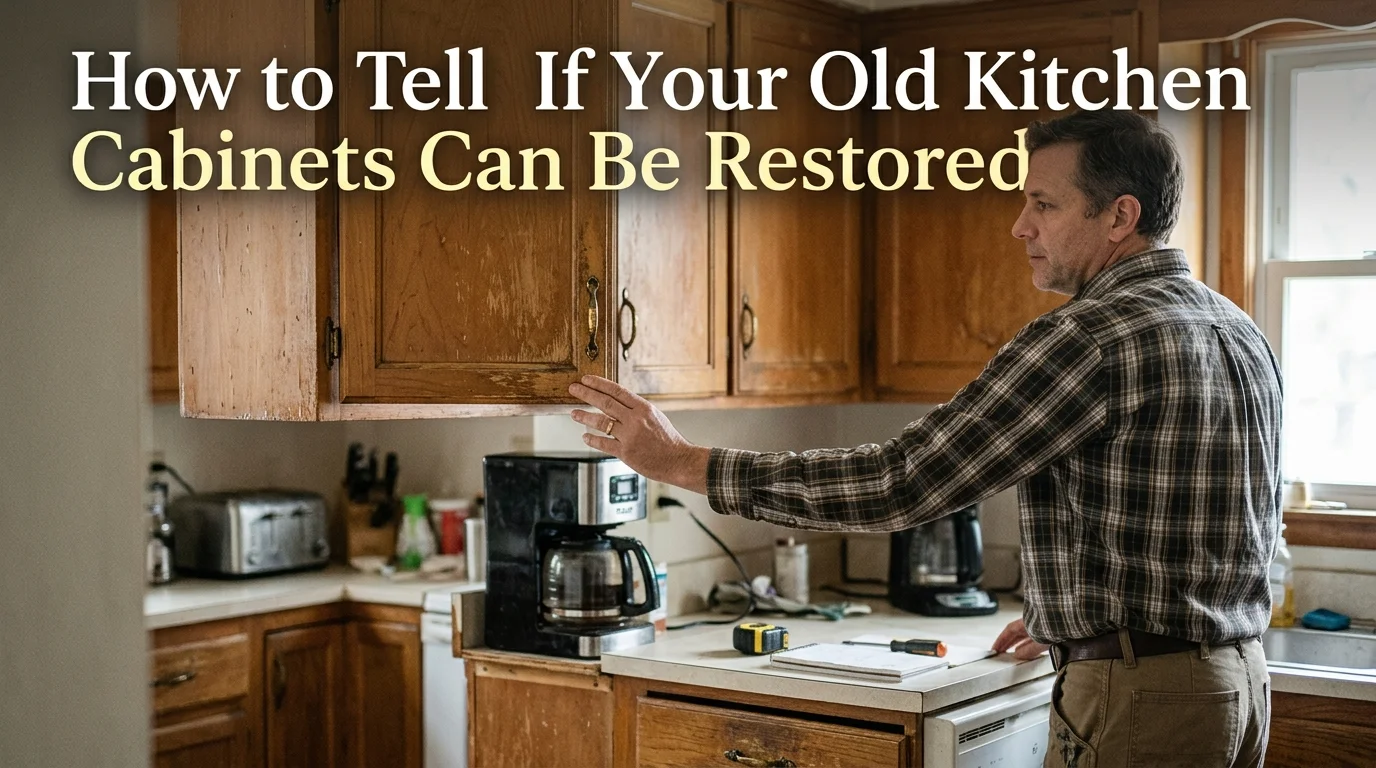
Scuffed edges. A finish gone dull around the handles. A door that won’t quite close flush anymore. None of it is dramatic, but together it makes a kitchen feel tired. And that’s usually when the replacement quotes start coming in. Here’s the thing, though. Worn and dated isn’t the same as finished. Old kitchen cabinet restoration doesn’t depend on how long the cabinets have been on the wall.
It depends on what’s under the wear and whether that’s still solid enough to bring back. So you have to look past the finish. Start with the boxes and frames. Then look at the surface damage, the doors and drawers, the hardware, and what the cabinets are actually made of. Moisture or structural trouble changes things. Let’s go through each one.
How Do You Know If Old Kitchen Cabinets Are Restorable?
First, divide the damage into three categories. If it’s cosmetic, it only affects the appearance of the cabinets. The problems with components are related to one component, such as a hinge that is worn out or a door that does not close. Structural problems concern the cabinet itself and determine whether old kitchen cabinets can be restored. And age? A well-constructed old cabinet can outlast a newer cabinet that sat over a leak.
Then, inspect the cabinet box. Remove items from a base cabinet and then press on the sides, bottom, and back. All should be solid. Press firmly on the frame, and look for gaps in the corners. When nothing bends or moves, it’s possible to repair old kitchen cabinets even if the finish is a little rough.
Which Types of Cabinet Damage Are Usually Repairable?
Most of what makes cabinets look old is cabinet surface damage. Hands, cleaning products, cooking heat, sunlight. They all wear a finish down, little by little. You’ll usually spot it first on fronts near the sink and stove and around the handles.
Some common problems that deserve a closer restoration assessment include:
- Surface scratches and fading
- Small dents or gouges
- Worn or dull finishes
- Loose hardware
- Minor door or drawer alignment problems
Apply a cabinet stain. That’s usually a wear-and-tear issue on the coating and not the wood itself. It may be possible to fill in scratches and small dents, depending on the depth, and refinishing may be possible for small gouges; solid wood is easier to sand than thin veneer. Slightly crooked doors and loose knobs are even easier. Typically, a kitchen cabinet repair involves tightening screws or making adjustments to hinges.
Peeling cabinet finishes are more challenging. Sometimes it just didn’t adhere, or it didn’t adhere properly, which is a surface problem. Other times heat or moisture has percolated into the material, and that is a bigger issue. It is important to look at these factors and repair worn kitchen cabinets, rather than tear them down. However, the kind of material and degree of damage will still determine the damaged kitchen cabinet restoration.
| Pro Tip: Don’t decide a cabinet by its door alone. A worn finish is a separate problem from a swollen cabinet box or deteriorated material underneath. |
What Parts and Materials Should You Check?
With the boxes out of the way, turn to the parts you handle every day and to what the cabinets are made of. Both affect how much can be saved.
Doors, Drawer Fronts, and Hardware
Doors and drawers get opened, closed, and bumped more than anything else in a kitchen, so they’re usually the first to show wear. Run your fingers along the panel edges and the corner joints, where cracks tend to start. Then shut the door and look down its length from the side, which makes a bow easy to spot. A warped door often won’t sit flat against the frame, and adjusting the hinges won’t change that. A crack is less serious than it looks, as long as it’s a clean split and the wood around it is still solid.
Drawers need a quick test of their own. The front shouldn’t wiggle, and the box shouldn’t rack out of square when you push on a corner. A drawer that sticks or drops, or a hinge that won’t stay where you set it, usually means tired hardware rather than a tired cabinet. Those parts, and even a single bad door, can be swapped out without touching the rest.
Cabinet Materials Matter Too
Solid wood is the most forgiving. It handles sanding and repairs without much fuss. Veneer can be refinished too, but its wood face is thin, so there’s little room for heavy sanding, and a damaged spot may need patching instead. Plywood boxes tend to age well. Particleboard is the weak point around water. It swells, and once it softens, screws start pulling out.
Don’t let the material make the decision for you, though. A particleboard box that has stayed dry and solid is a better bet than solid wood that has been soaking up a slow leak for years. What matters is the condition it’s in today.
When Does Moisture or Structural Damage Change the Decision?
Water is the big one. It’s the most common reason cabinets cross over from cosmetic problems to something more serious. The sink base takes most of the damage, but dishwasher and refrigerator-line leaks can reach other cabinets too. Water-damaged cabinets may show swelling along the edges and surfaces or a musty smell.
Give attention when you see:
- Swollen or deteriorated material
- Significant cabinet-box warping
- Widespread separation at joints
- Persistent moisture-related damage
- Structural instability
Here’s why it matters. Surface restoration can’t put strength back into material that’s lost it. You can sand and refinish a swollen panel, and it might look better for a while. The swelling is still there. So is the weakness. The same rules apply for a box that’s twisting or pulling apart. And if nobody fixes the moisture source, the damage can keep getting worse.
When Does Restoring Existing Cabinets Make Sense?
So far, it’s all been about physical condition. That’s only half of it. The other half? Whether the kitchen still works for you. It makes sense to restore existing kitchen cabinets when the boxes are sound, and most of the problems are cosmetic or repairable. A layout that works helps. So does enough storage for your household and doors and drawers that are serviceable or replaceable. Genuinely liking the cabinets you already have counts too.
The cabinet restoration vs. cabinet replacement question looks different when the problems go deeper. Significant structural deterioration can make restoration impractical. So can there be serious moisture damage across several cabinets or extensive component failure? And if the layout just doesn’t suit your needs, a broader kitchen renovation may be the better path. A new finish can’t fix poor workflow or missing storage.
No single choice is right for every kitchen. The point is to match the work to the cabinets’ actual condition and to what you want from the space.
What Does Professional Cabinet Restoration Involve?
Professional cabinet restoration starts with an inspection. Doors, hinges, and drawers get checked to see what needs repair first. Then comes cleaning. Cooking grease builds up on cabinet faces, and a new finish won’t adhere well over it. Dents and worn edges are repaired after that.
Once the surfaces are prepped, the finish goes on, chosen to suit the material and the look you want. Doors and drawers are then adjusted until they close properly. Methods vary between cabinet restoration services, but old cabinet restoration is usually less disruptive than pulling everything out.
How Much Does Kitchen Cabinet Restoration Cost?
There’s no fixed price. Kitchen cabinet restoration cost varies based on how many cabinets you have and what condition they’re in.
Typical Price Ranges by Kitchen Size
A tiny kitchen with up to 15 cabinets, such as a condo or a cosmetic project, normally falls between $1,500 and $3,500. Medium kitchens of 15 to 25 cabinets, standard in family homes, usually land between $3,500 and $6,500. Large or custom kitchens with more than 25 cabinets or detailed trim generally run $6,500 to $10,000 or more.
What Changes the Final Price
Labor quantity is greatly influenced by the number of doors and drawer fronts. A significant amount of time is added to the repairs in the event of major peeling or repairs for structures. It’s a different preparation for wood, laminate, and MDF, and new hardware and moldings (even custom ones) increase the total. The estimate that can only be done on-site is the one that should be budgeted for.
Frequently Asked Questions
Can old kitchen cabinets be restored?
Yes, typically, when the boxes and the frames are good enough, and the issues are primarily aesthetic (scratches, loose hardware).
How do you determine the condition of cabinet boxes?
If the sides and back seem strong, the joints are secure, and there is no rocking of the box, it is probably in good condition.
Are water-damaged kitchen cabinets repairable?
This depends: light staining can be repaired, but if the material is swollen or crumbling, it is likely it will need replacing, and the leak should be addressed first.
Are cabinet doors that have cracks in the hole fixable?
Yes, if it is an isolated, clean crack in stable wood, it is possible to replace the door without replacing the cabinet.
Should cabinet stripping be an excuse for cabinet replacements?
Not necessarily, because it can be refinished, but if it peels close to the sink, then it could indicate moisture damage, which is worth checking first.
What is the difference between cabinet restoration and replacement?
Restoration repairs and refinishes existing cabinets, while replacement does more, removing the old and replacing it with new cabinets.
What is the cost of restoration for old cabinets?
The average project size is $1,500 to $10,000 or more, depending on cabinet sizes, materials, and finishes, so an actual inspection is essential to determining this amount.
Final Thoughts
Cabinet age tells you less than cabinet condition. Restoration becomes realistic when the structure is sound, the materials hold up, and the surface damage is repairable. It also helps when there’s no serious moisture damage, the doors, drawers, and hardware are serviceable, and the layout still works.
Kitchen Redux offers professional cabinet restoration services in Hanson, MA, and across the South Shore. Not sure if your cabinets are worth restoring? Having your existing local cabinetry assessed in person is a sensible place to start. Once you know their real condition, choosing between restoration and a bigger kitchen change gets a lot easier.